
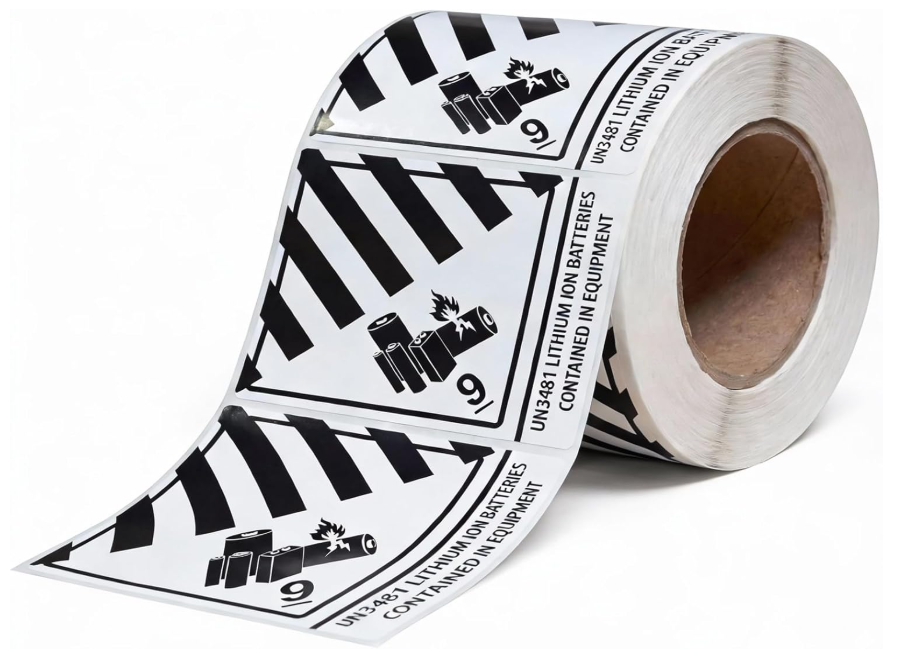
Class 9 Lithium Battery Label
Class 9 lithium battery hazard warning labels — DOT & IATA compliant with distinctive diamond marking for miscellaneous dangerous goods identification.
Introduction
Official Class 9 miscellaneous dangerous goods labels featuring the distinctive diamond shape with seven vertical black stripes recognized by shipping carriers, customs officials, and emergency personnel worldwide. These hazard class markers communicate that packages contain materials posing risks during transportation, triggering appropriate handling protocols throughout the supply chain. The diamond orientation and specific stripe pattern ensure instant recognition even from a distance in busy loading docks or cargo facilities.
Class 9 labels complement UN identification numbers by indicating the hazard classification category, a critical piece of information for transportation personnel making routing and storage decisions. Lithium batteries meeting certain watt-hour or lithium content thresholds require both UN identification and Class 9 hazard marking for regulatory compliance. Our labels use fade-resistant inks that maintain contrast clarity throughout extended shipping durations, including exposure to sunlight during outdoor storage or loading operations. Required for battery shipments by air, ocean, rail, and highway when capacity exceeds exemption limits established in transport regulations.
Class 9 Battery Label Specifications
| Parameter | Details |
|---|---|
| Material | Paper with protective laminate or polyester |
| Temperature Range | -4°F to 176°F (-20°C to 80°C) |
| Standard Sizes | 4″ x 4″ (100mm x 100mm) diamond orientation |
| Colors | Black vertical stripes on white background |
| Film Options | Laminated paper, Polyester, Rigid plastic placard |
| Adhesive Available | Permanent acrylic with high initial tack |
| Water Resistance | Moisture-resistant with optional lamination |
| FDA Compliance | N/A |
| Placement Requirements | Visible on two opposing sides of package |
| International Standards | UN Recommendations, IMO, ICAO Annex 18 |
Application Scenarios
Multi-Modal Transportation
Apply class 9 lithium battery label markings on shipments transferring between air, ocean, and ground transport requiring consistent hazard identification.
Customs Clearance Documentation
Class 9 battery label markings support customs declarations and dangerous goods manifests for international battery shipments crossing borders.
Warehouse Storage Segregation
Facility operators use Class 9 labels to identify storage zones containing miscellaneous dangerous goods requiring separation from incompatible materials.
Emergency Response Information
First responders rely on Class 9 hazard markings to quickly assess incident risks and select appropriate response procedures during transportation emergencies.
Carrier Acceptance Verification
Shipping carriers verify proper Class 9 labeling before accepting battery shipments, preventing delays and ensuring compliance with carrier policies.
Regulatory Compliance Requirements
Class 9 designation covers miscellaneous dangerous goods not fitting other hazard classes, including lithium batteries, dry ice, and magnetized materials. For lithium batteries, Class 9 marking is required when batteries exceed specific capacity thresholds—lithium ion cells over 20 watt-hours or batteries over 100 watt-hours, and lithium metal cells over 1 gram or batteries over 2 grams of lithium content. Packages must display Class 9 labels on at least two opposing sides for visibility from multiple angles.
Label dimensions follow strict specifications—the diamond must measure 100mm x 100mm minimum, with stripes and borders in precise widths. The bottom half of the diamond contains the text “9” indicating hazard class, with an optional underclass number for specific materials. Labels must be placed away from other markings that could obscure them, and damaged labels must be replaced before shipment acceptance. Our Class 9 labels meet all dimensional and color requirements specified in UN Model Regulations, DOT 49 CFR, IATA DGR, and IMDG Code.
Material Selection Guide
Choose label materials based on your shipping environment and handling conditions. Laminated paper labels offer cost-effectiveness for single-use shipments in controlled environments, with adequate durability for most domestic ground transportation. The protective laminate prevents smudging and provides moderate water resistance against rain or moisture exposure during loading operations.
Polyester labels deliver superior performance for international shipments or harsh conditions. The synthetic material resists tearing, maintains dimensional stability through temperature changes, and provides waterproof protection against saltwater spray in ocean freight. For permanent installations on reusable shipping containers or bulk storage bins, rigid plastic placards withstand repeated use and cleaning, with UV-resistant properties preventing fading in outdoor storage yards.
Related Products
Order Compliant Class 9 Labels
Our dangerous goods labeling team will ensure your Class 9 labels meet all dimensional and color requirements. Contact us for samples and volume pricing.