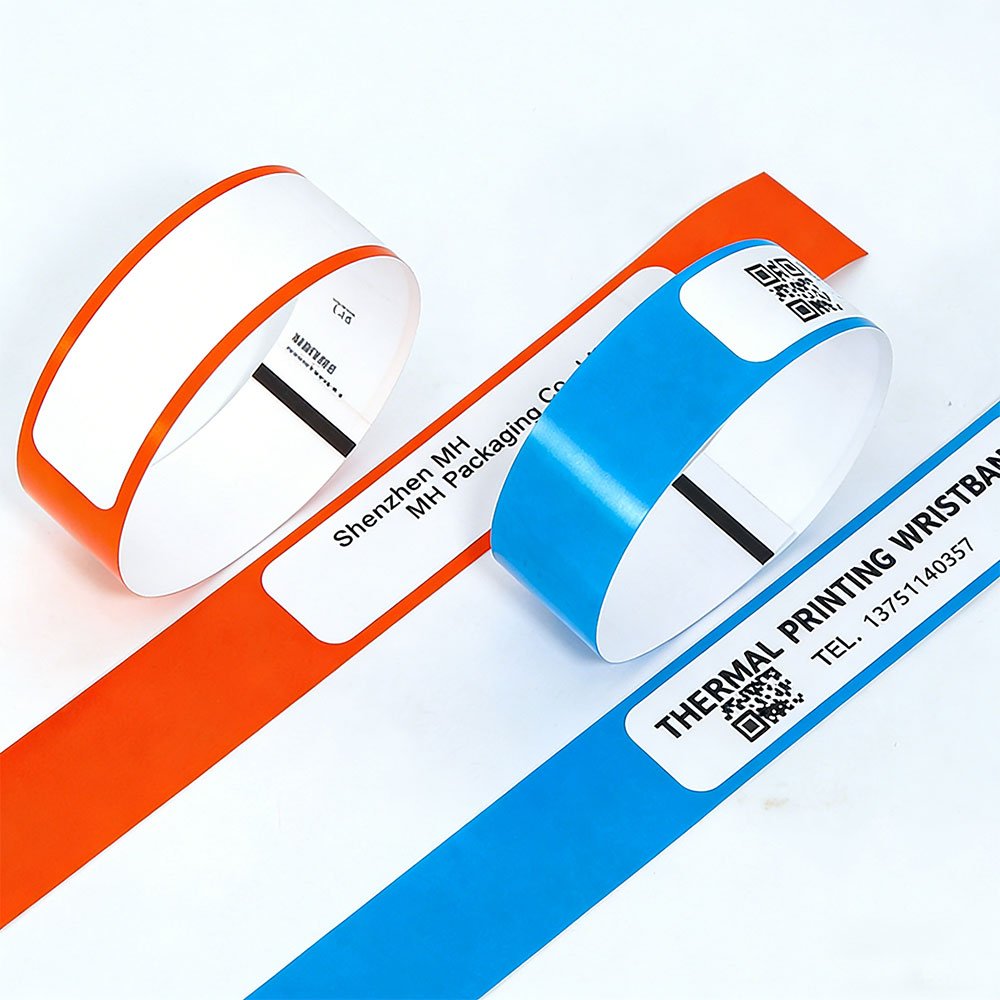
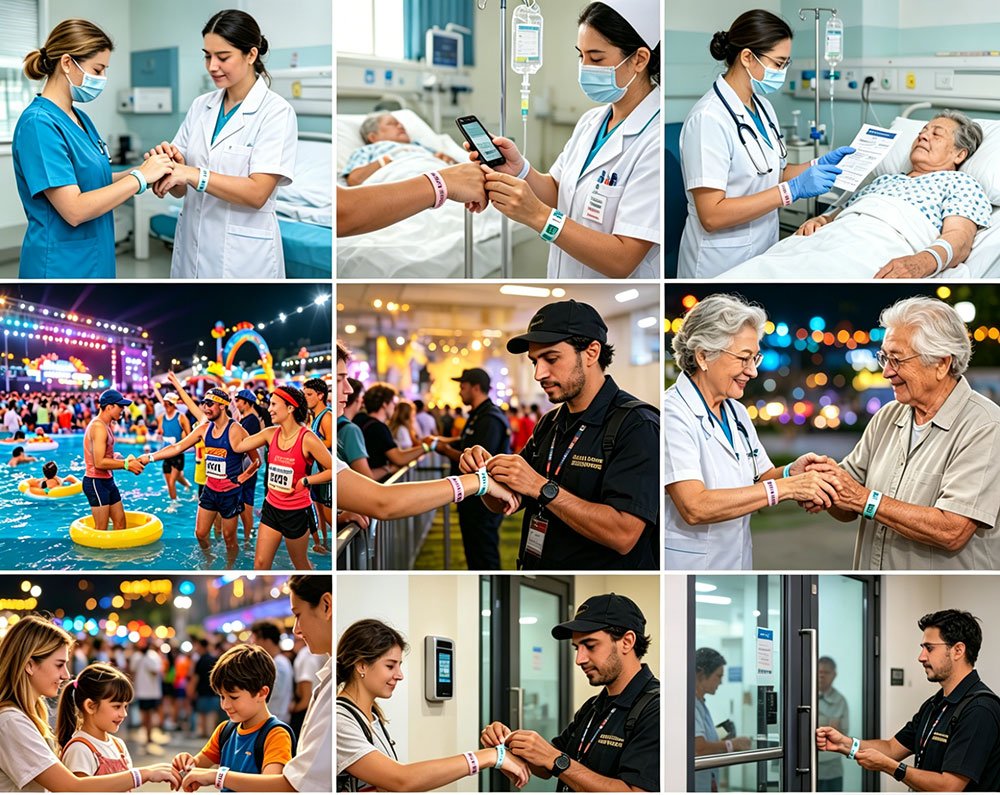
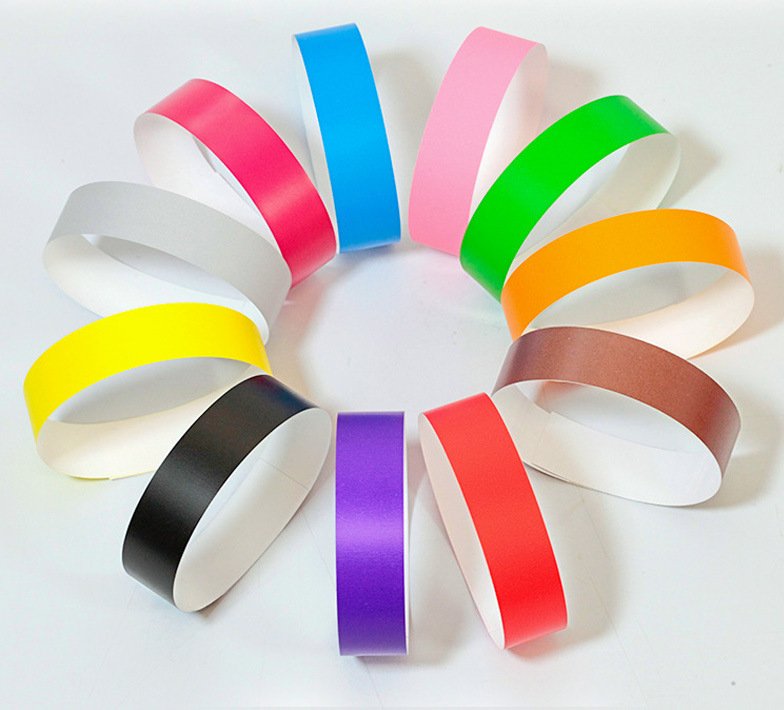
In-Depth Wristband Material Analysis

The following section compares the materials from three angles: performance, suitable applications, and processing compatibility.

See also: label material selection comparison

Tyvek wristband material

Tyvek Material

Tyvek is a high-density polyethylene fiber nonwoven material that combines paper-like printability with the toughness of a fiber structure. Its microporous structure gives it good breathability and a light hand feel, so it remains comfortable against the skin without feeling stuffy. It is a good fit for applications where comfort and safety both matter.

Tyvek is widely used for medical wristbands and other high-contact applications. It offers a low risk of skin irritation, a structure that is neither paper nor fabric, and resistance to everyday contact with alcohol, povidone-iodine, and perspiration.

Core performance: suitable for medical use, low risk of skin irritation, breathable and skin-friendly, resistant to alcohol / povidone-iodine / perspiration, stable print contrast, and easy to scan.

Available processes include thermal coating printing, barcodes and QR codes, variable serial numbers, precision die-cutting, one-time tear-off closure, rounded corners, punching, color printing, logo customization, and anti-scratch treatment.

The main considerations are a relatively higher price and limited suitability for long-term soaking or repeated abrasion from sharp objects. For hospitals, maternal and infant care, emergency departments, and other applications that require strong medical reliability, Tyvek is often the preferred wristband material.

Industries: Hospitals, clinics, maternal and infant identification, music festivals, sports events, and premium events.
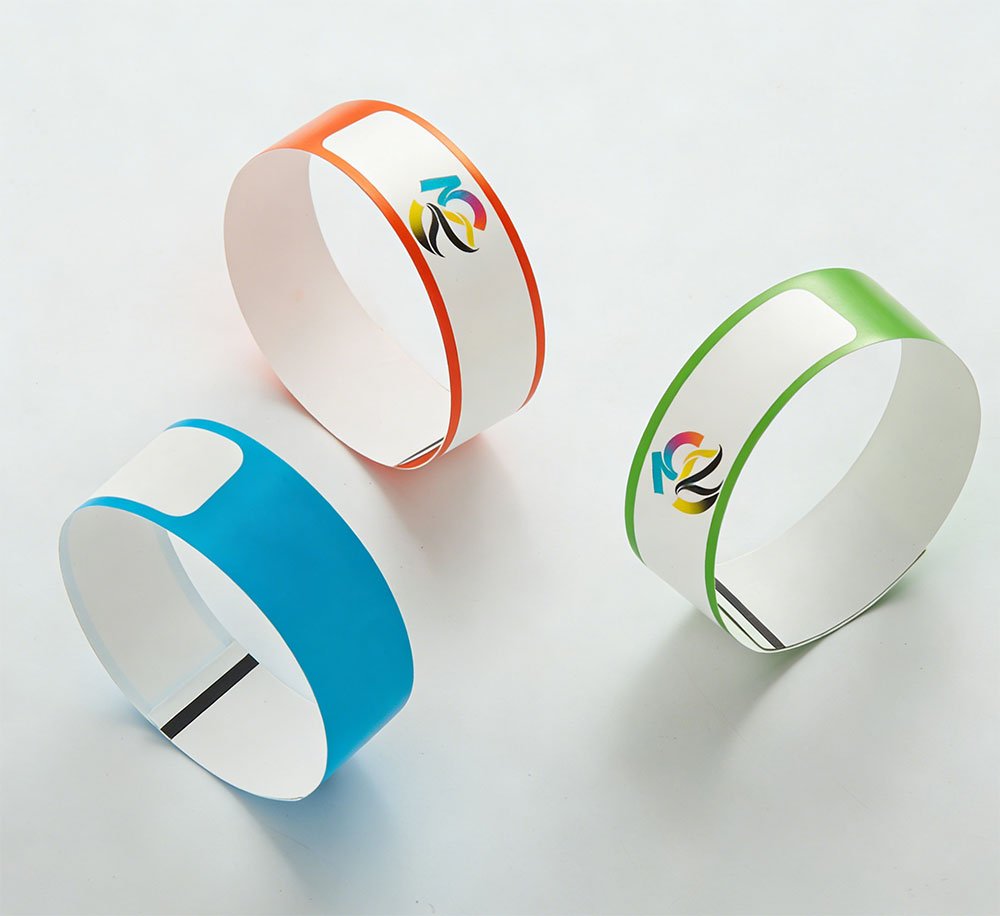
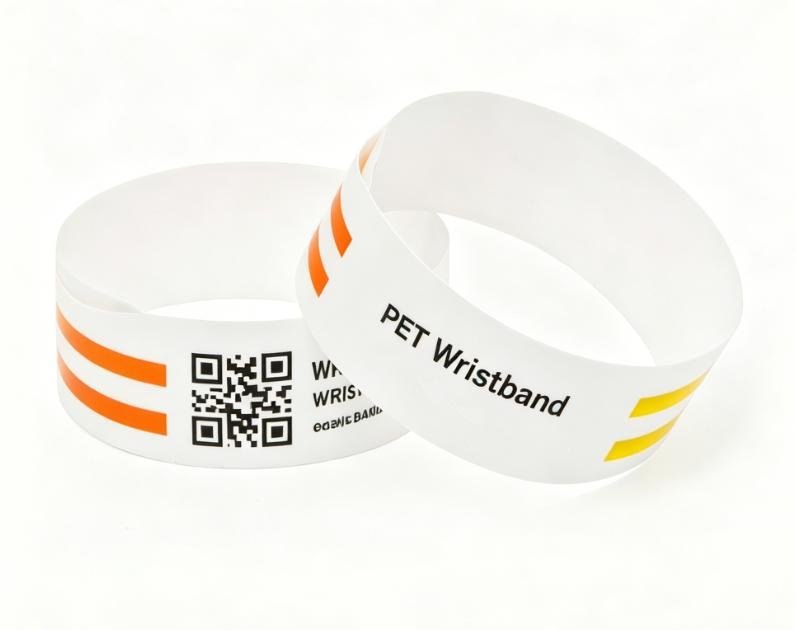
PP synthetic paper wristband material

PP Synthetic Paper Material

PP synthetic paper offers basic water resistance, moisture resistance, and a degree of tensile strength. It works well for short-term wear, fast check-in workflows, and large-volume low-cost production.

Core performance: low cost, basic water resistance, moisture and oil resistance, bend resistance, compatibility with mainstream thermal printing, and a good fit for short-cycle disposable use.

Available processes include thermal coating printing, barcodes and QR codes, variable serial numbers, die-cutting, punching, rounded corners, color printing, logo printing, and low-cost mass cutting.

Its limitations are moderate breathability, surface whitening after repeated bending, reduced toughness in low temperatures, and a higher chance of blurred thermal print under high heat settings.

If your project prioritizes budget control, fast delivery, and 1–3 day use, PP is often the most practical choice.

Industries: Trade shows, registration, promotions, access control, parties, and temporary events.

PET polymer film wristband material

PET Polyester Film Material

PET is a high-strength polyester film with excellent scratch resistance, sun resistance, immersion resistance, and chemical resistance. It performs consistently in outdoor, wet, or long-term identification environments.

Core performance: high scratch resistance, UV resistance, immersion resistance, acid and alkali resistance, heat resistance, and strong tensile performance, making it well suited to demanding long-term identification environments.

Available processes include waterproof lamination, custom thermal coating, barcodes and QR codes, variable serial numbers, die-cutting, punching, rounded corners, hot stamping, and premium branded packaging.

That said, PET is relatively rigid and less comfortable against the skin, with weaker breathability. Thermal printing is also not its strong point, so stable color development usually requires a dedicated thermal coating and printer validation.

If your project emphasizes durability, water resistance, weather resistance, and long wear, PET is often the best fit among these three materials.

Industries: Water parks, outdoor camping, long-term identification, and industrial marking.

Deep Comparison Chart: Tyvek vs. PP vs. PET

If your top priorities when choosing thermal wristbands are print clarity, scan reliability, wearing comfort, and budget, the comparison below can help you find the right material.

Comparison FactorTyvekPP Synthetic PaperPET Polyester Film
Base Material CharacteristicsHigh-density polyethylene fiber nonwoven structure with both paper-like feel and fiber toughnessPlastic-based material with a paper-like texture, suitable for economical mass productionHigh-strength polyester film designed for high-durability applications
Thickness / Hand FeelLightweight, flexible, matte, and soft to the touchRelatively firm, decent toughness, and moderate wearing comfortRigid, smooth, high-gloss, with weaker skin comfort
AdvantagesWater-resistant, alcohol-resistant, sweat-resistant, tear-resistant; crisp thermal print; breathable and skin-friendlyLow cost, easy to cut, and compatible with mainstream thermal printersScratch-resistant, chemically resistant, heat-resistant, waterproof, and well suited to long-term identification
LimitationsHigher cost, not suitable for long immersion, and can be damaged by sharp objectsAverage breathability, prone to whitening after repeated bending, and brittle in low temperaturesRigid, non-breathable, and requires a dedicated thermal coating for thermal compatibility
Thermal Print Clarity & Scan CompatibilityBest in class, with stable color development, high contrast, and excellent barcode / QR readabilityWorks with mainstream thermal printers, but high-temperature printing can blur the image and long-term friction may cause fadingColor development may vary by printer; dedicated thermal coating and sample testing are recommended
Water / Alcohol / Sweat / Chemical ResistanceResistant to water, alcohol, povidone-iodine, and sweat, making it well suited to medical useBasic water resistance only; not suitable for long soaking, and repeated alcohol wiping may affect print clarityFully waterproof, oil-resistant, acid- and alkali-resistant, and heat-resistant, with strong performance in aquatic environments
Service Life1–7 days1–3 days7–30 days
Allergen Risk & Skin FriendlinessLow allergen risk, skin-friendly, and breathable, well suited to hospitals, maternal care, and childrenUsable, comfort is average during long wearRigid and non-breathable, so it is not ideal for long-term skin contact
Processing CompatibilityMost mature tear-off closure process; well suited to precision die-cutting, QR codes, serial numbers, and medical productsSuitable for low-cost mass production, with efficient die-cutting and conventional printingCan support lamination, hot stamping, and premium durable structures for long-term identification
Cost RankingHighestLowestMedium to high

Example 1: DUPONT™ TYVEK® 1056D Data Sheet

The following reference data is based on the sample specification and helps customers better understand the material properties before deciding.

PropertyComparable Test MethodUnitsTyvek®
Product FeaturesAntistatic Treatment / Corona Treated
Basis WeightDIN EN ISO 536 (96)g/m²55.0 [52.5–57.5]
DelaminationASTM D2724-07N1.0 [0.7–1.3]
ThicknessDIN EN ISO 534 (05)μm175
OpacityISO 2471 (98)%97.8
Tensile Strength, MDDIN EN ISO 1924-2 (08)N120
Tensile Strength, CDDIN EN ISO 1924-2 (08)N115
Elongation, MDDIN EN ISO 1924-2 (08)%10–16
Elongation, CDDIN EN ISO 1924-2 (08)%13–20
Elmendorf Tear, MDDIN EN 21974 (94)N8.1
Elmendorf Tear, CDDIN EN 21974 (94)N7.2
MullenburstISO 2758 (01)kPa680

MD = machine direction; CD = cross direction.

  1. Modified for size: 100 cm2
  2. Modified for: result interpretation – length of delamination = 116 mm, width 25.4 mm, speed = 127 mm/min and clamp distance = 60 mm
  3. Surface 2 cm2, pressure 50 kPa
  4. Modified for: backing standards, measuring area, and illumination = wide area.
  5. Modified for: speed = 100 mm/min, width 25.4 mm and gauge length = 127 mm

For more detailed data tables, please open the PDF data sheet. Open PDF data sheet

Example 2: PP Synthetic Paper 0.075mm Data Sheet

The following reference data is based on the sample specification and presents the material data in a clear, structured format.

Surface MaterialPGLinerWG80
Material Name0.075mm synthetic paperMaterial Name80g liner-release backing
Thickness(um)75±5Thickness(um)62±5
Basic Weight59±5Basic Weight(g/m²)80±5
ColourWhiteColourWhite
Surface Treatment(#)≥38 (PILLAR)Release force(g/24mm)4-11
Adhesive
Test ItemValueUnitTest Method
AdhesiveCL51//
Product thickness20±3umCM-PWT8.6-29A
Adhesion to Steel1.0-1.8Kgf/25mmGB/T 2792-2014 (20min)
Initial Tack≥3#GB/T4852-2002
Holding Power≥24HGB/T 4851-2014 (20min/24mm*24mm)
Temperature Range-20-100°C
Minimum Labeling Temperature10°C
Valid Period12monthBased on the normal storage condition, if over the valid period, please test or ask help from us before use.
Storage ConditionStore indoors at 23±2°C and 65±5%RH; keep away from high temperature, heavy load, and direct sunlight. Please confirm the application condition before use.

Example 3: PET 0.048mm Data Sheet

The following table is based on the sample specification and presents the PET material details in clear English for customers who want to understand the material features and where it works best.

ItemSpecificationUnitTest Method / Remark
Surface MaterialWBETM48(TC)//
Material Description0.048mm white PET/CM-PWI8.6-02B
Basic Weight67±3g/m²CM-PWI8.6-02B
Thickness48±3umCM-PWI8.6-29A
ColorWhite//
Adhesive
Material DescriptionPermanent adhesive/CL12
Thickness19±3umCM-PWI8.6-29A
Liner
Material Description80g white glassine release liner//
Basic Weight80±5g/m²CM-PWI8.6-02B
Thickness67±5umCM-PWI8.6-29A
ColorWhite//
Technical Parameters
Surface Treatment≥38 dyne (PILLAR)/CM-PWI8.6-02B
Loop Tack1.6±0.3Kgf/25mm²FINAT / FTM9
Peel Strength1.3~2.1Kgf/25mmGB/T 2792-2014 (20min)
Holding Power≥24HGB/T 4851-2014 (20min/24mm*24mm)
Release Force3~13gf/24mmCM-PWI8.6-11A
Temperature Range-20 ~ 100°C/
Printing
Good dimensional stability; excellent adhesion; environmentally friendly.
Environmental Protection
Compliant with EN71-3:2019, Migration of Certain Elements, 94/62/EC, RoHS (Directive 2002/95/EC), 2005/84/EC (EU Phthalate Directive), PAHs, Halogen, PFOA & PFOS.
Valid Period
From the date of shipment, it can be stored for 1 year under 23±2°C / RH50±5% conditions.

Customization Compatibility for Tyvek, PP and PET Materials

For brand-customization customers, all three materials support basic production processes, but their processing performance differs significantly in real applications.

Commonly Supported Processes

Thermal printing, barcodes / QR codes, variable serial numbers, die-cutting, one-time tear-off closure, rounded corners, punching, color printing, logo customization, waterproof lamination, and anti-scratch treatment.

Tyvek Process Advantages

The tear-off closure process is highly mature, making it well suited to precision die-cutting and medical production. It is one of the most commonly used wristband substrates for hospitals and projects that require strong identification control.

PP and PET Production Focus

PP is better suited to large-volume, cost-conscious production, while PET supports lamination, hot stamping, and durable constructions, making it a better fit for long wear and branded packaging.

Thermal Wristband Specification Parameters and Customization Solutions

The following parameters are a practical reference and can be adjusted according to printer model, industry standards, and your custom requirements.

ItemTypical RangeCustomization Options
WidthCommonly 19–25 mmCan be customized to narrower or wider sizes based on print area, wearing comfort, and branding needs
LengthAdult, child, and infant lengths availableCan be customized according to wrist circumference, wearing method, and closure structure
Thickness / Basis WeightStandard thickness can be supplied according to material and applicationSupports thicker structures, anti-scratch treatments, waterproofing, and lamination optimization
Color / PrintingWhite, color, and brand-specific base colors availableLogo, pattern, barcode, QR code, serial number, and variable data printing
Structural StyleOne-time tear-off closure, punching, rounded corners, and other conventional structuresClosure method, die-cut shape, and anti-tamper structure can all be customized
PackagingBulk, roll, and box packaging availableSupports OEM outer packaging, barcode labeling, and batch-managed packaging
MOQ / Lead TimeDepends on material and processSupports small-batch sampling and stable mass delivery

All three materials support thermal printing, barcodes / QR codes, variable serial numbers, die-cutting, one-time tear-off closure, rounded corners, punching, color printing, logo printing, custom patterns, waterproof lamination, and anti-scratch treatment.

Among them, Tyvek has the most mature tear-off closure process and is ideal for medical and high-security products; PP is better for large-volume low-cost production; PET is more suitable for lamination, hot stamping, and premium durable wristbands.

If you are looking for a thermal wristband solution that balances scan efficiency, wearing experience, and delivery cost, we can recommend the most suitable substrate based on your industry and expected wear duration.

Custom thermal wristband production

Guidance on Thermal Wristband Sample Testing

Before placing a formal bulk order, sample validation is strongly recommended, especially for medical, water-park, long-wear, and frequent-scanning projects. This helps customers confirm whether the material matches their actual use conditions.

5 Key Test Metrics

Print clarity, scan recognition rate, readability after alcohol wiping, wearing comfort, and whether the wristband fades, frays, or curls at the edges.

Medical and Maternal / Infant Projects

Focus on skin friendliness, alcohol resistance, povidone-iodine resistance, and comfort during continuous wear.

Water and Outdoor Projects

Validate immersion resistance, sun resistance, abrasion resistance, and print stability in high-humidity environments to confirm long-term readability.

We usually recommend sampling first, then confirming the final material based on the actual printer parameters, use environment, and wear cycle. This significantly reduces rework and field-use risk.

How to Choose the Right Thermal Wristband Material? Match the Use Case Directly

Different applications place different demands on comfort, print stability, water resistance, and budget. The guidance below can help customers choose the right material for their needs.

Hospitals / Medical, Maternal & Infant, Safety-Friendly and Alcohol / Iodine Resistant

Tyvek is the first choice. It offers the strongest medical suitability and the best overall performance, especially for clinical identification, patient management, and maternal-infant systems.

Short-Term Events, Registration, Low-Cost Promotions, 1–3 Day Use

Choose PP first if you want a budget-friendly option for bulk projects with short usage cycles.

Water Parks, Outdoor Long Wear, High Abrasion Resistance, 7+ Days

Choose PET first if you need strong durability for high-wear, sun-exposed, wet, or long-term use scenarios.

Bulk Disposable Access Control and Temporary Event Wristbands with Budget Control

For budget priority, choose PP; if brand image, print stability, and skin friendliness matter more, upgrade to Tyvek.

Need Crisp Printing, Stable Scanning, and No Smudging

Tyvek is preferred, followed by PP. PET should be sampled and validated before mass production.

Long-Term Outdoor or Heavy-Duty Projects

PET performs well in weather resistance and abrasion resistance, making it suitable for applications that require long-term identification and repeated contact.

Common Thermal Material Selection Mistakes

Many problems are not caused by a “bad material,” but by a mismatch between the material and the actual use case. The mistakes below are very common.

Mistake 1: Only Looking at the Lowest Price

The lowest unit price does not always mean the lowest total cost. If there is fading, blurred print, complaints, or rework, the overall cost can end up higher.

Mistake 2: Assuming All Thermal Wristbands Are the Same

Thermal coating compatibility, print density, and scan stability vary significantly by substrate, so appearance alone is not enough.

Mistake 3: Focusing Only on Water Resistance and Ignoring Comfort

In medical and maternal-infant scenarios, comfort and low allergen risk are often just as important as water resistance.

Mistake 4: Using Short-Term Material for Long-Term Wear

Materials designed for 1–3 days are not a good match for 7+ day scenarios, especially outdoors or in high-friction environments where failure is more likely.

Mistake 5: Assuming High Durability Automatically Means Medical Suitability

For medical use, skin friendliness, compliance, and print stability should come first, not durability alone.

Mistake 6: Placing an Order Without Sample Validation

Different printers, temperature settings, and environments all affect final performance, so sampling is the key risk-reduction step.

Tyvek, PP and PET Materials Application Case Breakdown

Matching each industry with a real use case helps customers quickly see which material is the better fit.

Healthcare

Hospital inpatient wristbands, newborn identification, emergency triage, and outpatient registration. Tyvek is a good fit here, with emphasis on skin comfort, alcohol resistance, and print clarity.

Entertainment Events

Music festivals, concerts, exhibition check-in, themed parties, and carnival admission. Tyvek or PP are both workable choices: Tyvek if comfort matters more, or PP if the budget and usage time are more limited.

Water Parks / Outdoor Use

Water parks, outdoor camping, extended sun exposure, and humid environments. PET is a strong choice here, with emphasis on waterproof performance, UV resistance, abrasion resistance, and long-term readability.

Retail / Access Control / Parties

Retail promotions, disposable access control, short-term event wristbands, and temporary check-in. PP is a good match for cost-sensitive, short-cycle scenarios.

Long-Term Identification / Industrial Marking

Factory inspection, equipment identification, warehouse zoning, and long-wear identification. PET is a good choice when higher scratch resistance, weather resistance, and structural stability are required.

Premium Events / Medical-Grade Projects

Premium brand events, maternal-infant management, and medical-style temporary identification. Tyvek works well because it offers a good balance of print stability, wearing comfort, and a clean professional look.

Frequently Asked Questions

1. Why is Tyvek often chosen for medical use?

Tyvek offers good skin friendliness, breathability, alcohol resistance, and povidone-iodine resistance, which makes it a strong fit for medical environments. Its print clarity and scan reliability also suit clinical workflows well.

2. Which material should I choose if my budget is limited?

If the project cycle is short, comfort requirements are modest, and budget sensitivity is high, PP is usually the first choice.

3. Why is PET suitable for water parks and outdoor use?

PET offers strong scratch resistance, sun resistance, immersion resistance, and chemical resistance, which makes it well suited to demanding environments and longer wear cycles.

4. Is PET thermal printing unstable?

PET thermal compatibility is usually not as strong as Tyvek or PP. We recommend a dedicated coating and sampling first to confirm contrast and scan performance.

5. Can all three materials support QR codes and serial numbers?

Yes. Tyvek, PP, and PET can all support barcodes, QR codes, variable serial numbers, and custom printing, although print clarity and durability differ by substrate.