
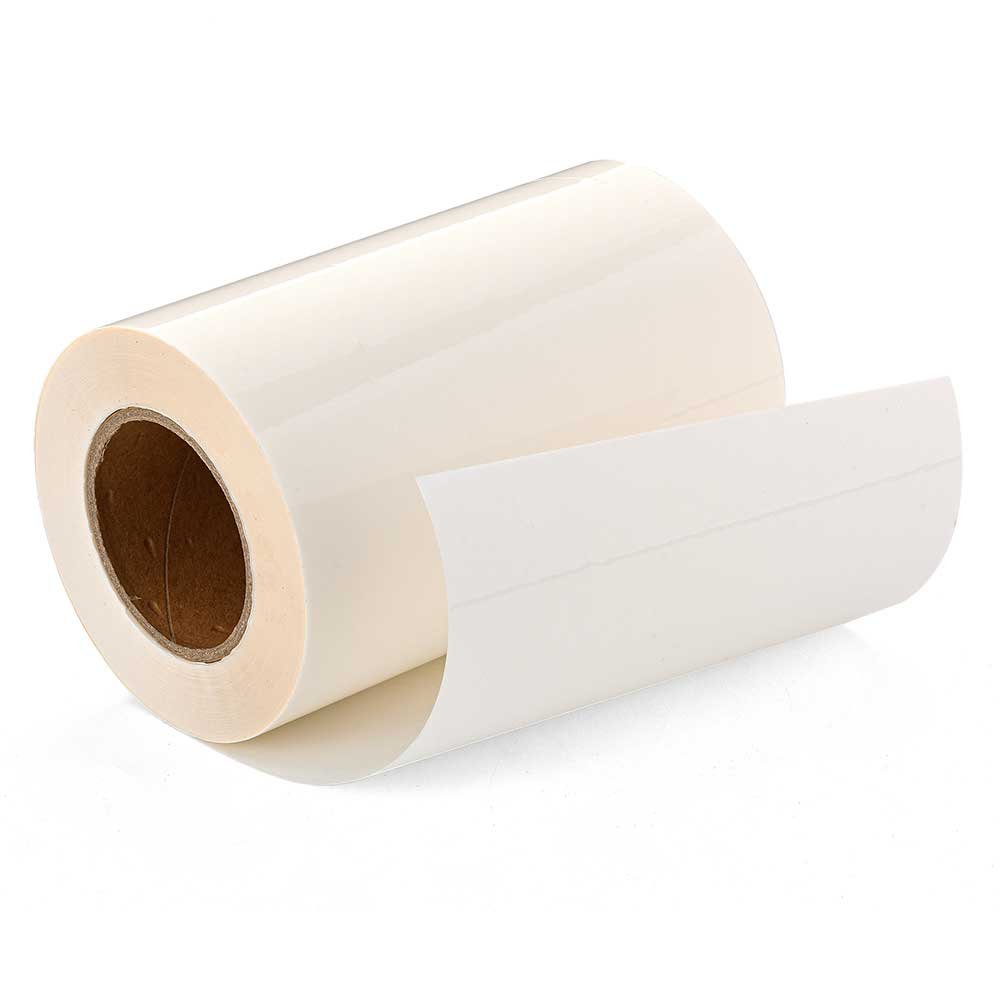
Anyone who’s worked on outdoor municipal lighting jobs knows how much trouble cheap labels can create. Standard paper or low‑grade plastic tags don’t hold up on street lamp housings—constant heat from bulbs, harsh sunlight, rain and coastal humidity quickly make them curl, peel, or blur all printed and handwritten details. Maintenance crews end up re‑tagging fixtures over and over, wasting time and project budget on repeated replacements.
Power distribution authorities have put together a complete set of official specs for dedicated heat resistant street lighting labels to fix this persistent asset tracking problem. These labels are built exclusively for road lamp lifecycle management, with strict rules covering size, raw materials, adhesive coating, roll formatting and writing performance. I’ll break down every practical requirement from the official technical annex, share real‑world use cases, walk through the mistakes most buyers make when sourcing these tags for large lighting projects, and introduce our matching material solution for this application.
Core Official Technical Specifications For Street Lighting Heat Resistant Labels
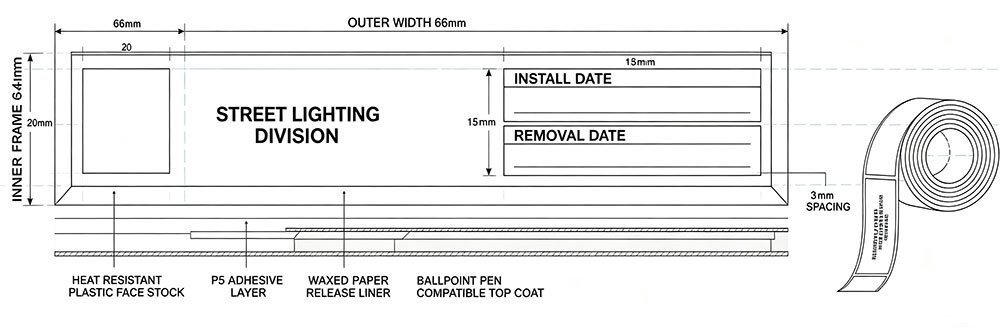
This label layout is designed for power department street lighting divisions, with dedicated blank sections to log install and removal dates for every lamp unit. Every measurement and production rule is clearly outlined in the standard documentation.
Exact Size Rules And Tolerance
All measurements are listed in millimeters, with an overall production tolerance of plus or minus 1 millimeter.
‑ Total outer width of each full label: 66mm
‑ Inner printed frame width: 64mm
‑ Fixed vertical height for the entire tag: 13mm
‑ Internal layout split:
- Left 20mm fixed block printed with STREET LIGHTING DIVISION
- Two equal blank columns on the right, each 13mm wide, reserved for hand writing INSTALL DATE and REMOVAL DATE ‑ Labels are wound on rolls along the 13mm vertical edge, matching standard automatic labeling machine workflows ‑ Individual tags are spaced 3 millimeters apart on the liner to simplify die‑cutting and peeling during mass application
Mandatory Material And Adhesive Rules
- Label face stock: Must use heat resistant plastic as the base material. This substrate is engineered to withstand sustained high temperatures from lamp enclosures without shrinking, warping or cracking over years of outdoor exposure.
- Rear adhesive layer: Grade P5 glue must be evenly coated across the entire back of every label. Uneven glue application is not permitted, as it creates weak adhesion spots on metal poles and plastic lamp casings.
- Release liner backing: Waxed paper is required as the roll liner. It creates a smooth barrier to protect the adhesive before use and lets labels separate cleanly during automated labeling.
- Front surface finish: The top side of the label has a specialized coating that works with any regular ballpoint pen. Handwritten dates won’t smudge, run or fade when exposed to moisture or direct sunlight.
Roll Format Production Requirements
Finished labels come pre‑mounted on continuous waxed paper rolls, separated by a 3mm gap between each individual tag. This roll format is made specifically for factory batch labeling instead of loose single sheets, drastically speeding up work when thousands of lamp fixtures need tagging during large municipal rollouts.
Our Practical Material Solution For Street Lighting Heat Resistant Labels
After matching client specification requirements against our existing material portfolio, our CT2307 construction is fully qualified for this street‑light label project.
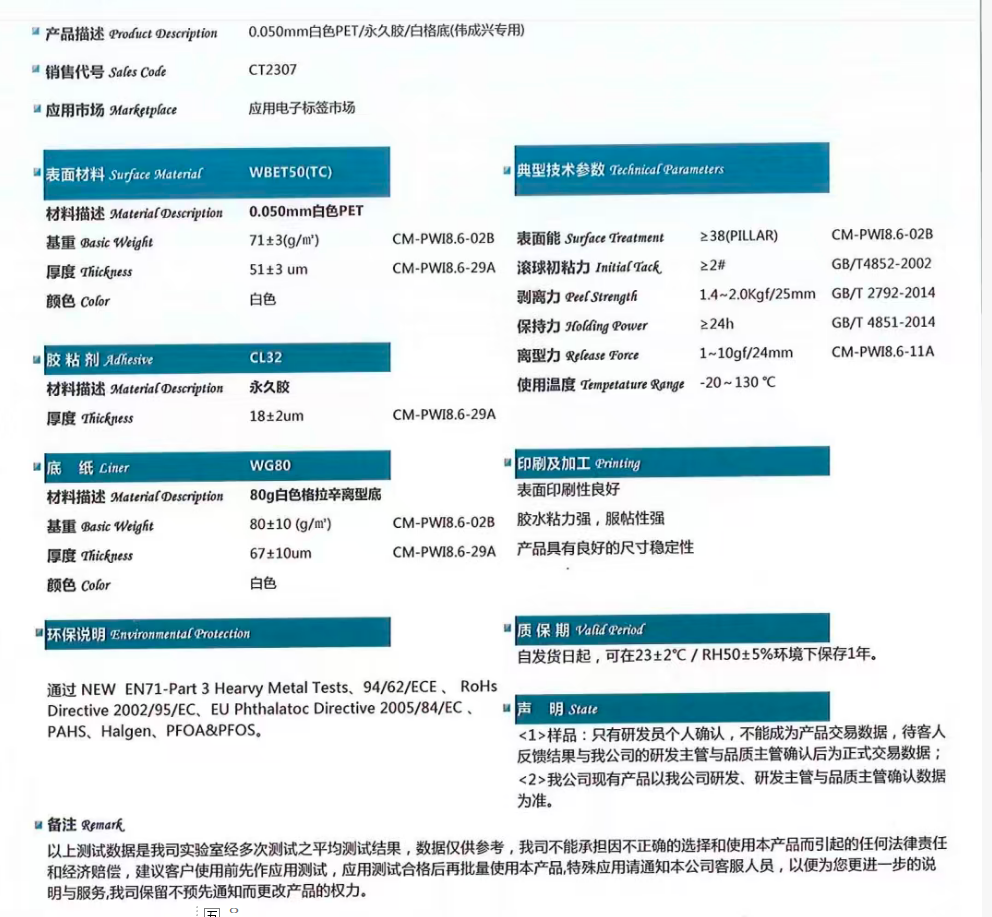
- Face stock: 0.050 mm white PET (WBET50(TC)), 51±3 μm thickness. The PET material delivers good dimensional stability under temperature swings, the treated surface supports ball‑pen handwriting and crisp black printing, meeting the project’s heat‑resistant plastic substrate requirement.
- Adhesive: CL32 permanent adhesive. Operating temperature spans ‑20 ℃ to 130 ℃, perfectly coping with long‑term heat radiated by lamp housings. Strong initial tack and holding power prevent edge lifting even on metal and plastic lamp surfaces.
- Release liner: WG80, 80g white glassine release liner. Equivalent performance to customer‑specified wax paper liner; clean die‑cutting, easy peeling for roll‑form automatic labeling.
- Compliance: Material passes RoHS, PAHs, Halogen, PFOA & PFOS and heavy‑metal testing, compliant for overseas municipal project delivery.
- Processing performance: Good printability, strong ink anchorage, stable die‑cutting, supports roll‑to‑roll converting with 3 mm gap between labels. Shelf life 1 year under recommended storage environment.
This material solves three main on‑site pain points at once: high‑temperature resistance for lamp housing heat, reliable adhesion for long‑term outdoor use, and smooth processing for high‑volume roll production. We can produce the requested 13 mm × 64 mm finished labels with ±1 mm tolerance, roll packing with max 500 pieces per roll, and print custom beige RAL 1000 background plus required black text content.
Why Heat Resistant Plastic Base Material Is Non‑Negotiable For Street Light Tags
A lot of project buyers try to cut costs by picking coated paper or thin generic BOPP film labels, and this shortcut always leads to costly rework down the line. Street lamp housings hold steady high heat for hours every night, paired with nonstop UV sun exposure all day long—conditions regular label substrates can’t handle.
Basic paper labels turn brittle, yellow and fall off within just a few months of installation. Cheap thin plastic softens under constant warmth, smearing handwritten notes and breaking the adhesive bond at the label edges. Coastal sites add another layer of stress with salt fog and wide daily temperature swings, accelerating degradation even faster.
The heat resistant plastic outlined in the official spec solves all these pain points with consistent thermal stability. It stays flat and intact under prolonged high heat exposure, resists sun fading for multiple years outdoors, repels moisture to stop ink bleeding, and won’t absorb humidity even in damp coastal environments. The matte top coating locks ballpoint pen ink in place, so maintenance records stay legible through wind, rain and seasonal weather shifts.
The Real Benefits Of Grade P5 Adhesive For Outdoor Lighting Assets
Not all pressure‑sensitive adhesives perform the same outdoors, and low‑temperature generic glues fail quickly on hot lamp surfaces. The specified Grade P5 adhesive addresses three major field issues crews deal with constantly:
First, it holds strong under sustained high heat. It won’t thin out, flow, or lift away from lamp housing surfaces even after months of daily heating cycles. Second, the full uniform coating eliminates bare spots, so every section of the label sticks evenly to smooth metal and textured plastic fixture surfaces alike. Third, it handles extreme climate shifts—salt air, high humidity and big swings between daytime heat and nighttime cool don’t trigger edge lifting or bubbling.
Paired with waxed paper liner, the adhesive layer stays fully protected during long‑term roll storage. Tags won’t stick to one another when unspooled for machine labeling, avoiding production delays at lamp manufacturing facilities.
Practical Project Advantages Of Standard Roll Style Heat Resistant Labels
Streamlined Long‑Term Equipment Tracking
Every lamp fixture gets its own dedicated space to log install and removal timelines. Maintenance teams can instantly reference each unit’s service life, replacement schedule and service history without digging through spreadsheets or old paper files. This cuts down on unnecessary site visits and makes planned overhaul work far more efficient for large lighting networks.
Faster Batch Processing For Big Infrastructure Projects
Roll stock with consistent 3mm spacing fits seamlessly with automated labeling equipment used by lamp manufacturers. Compared to handling loose single labels one at a time, roll formats slash manual labor time when tagging hundreds or thousands of fixtures for municipal infrastructure tenders.
Lower Long‑Run Project Maintenance Costs
Investing in spec‑compliant heat resistant labels eliminates recurring labor and material costs from re‑tagging failed old labels. For public infrastructure tenders with multi‑year service requirements, this consistent durable tag solution aligns perfectly with long‑term budget planning and avoids unexpected supplementary purchase orders mid‑contract.
Cross Region Compatibility For Municipal Lighting Tenders
This full set of dimensional, material and roll formatting rules is widely referenced for outdoor lighting projects across coastal high‑temperature regions. The unified layout and performance standards remove the hassle of custom new molds or lengthy technical approval rounds for cross‑border tender bids, simplifying coordination between contractors, manufacturers and local power authorities.
Top Sourcing Mistakes That Cause Project Acceptance Delays
- Swapping heat resistant plastic base for coated paper or low‑cost thin film: These tags fail thermal testing and won’t pass official project acceptance checks.
- Substituting generic low‑temperature glue instead of Grade P5 adhesive: Labels start peeling off lamp housings within months of installation.
- Ignoring the 1mm size tolerance rule: Tags won’t fit the pre‑designated labeling area on lamp enclosures, forcing full batch rework.
- Using standard paper liner instead of waxed backing: Adhesive sticks between stacked labels on rolls, breaking automated labeling workflows entirely.
- Skipping the specialized writable top coating: Ballpoint pen ink smudges or washes away with rain, rendering asset tracking records useless.
Closing Thoughts
Heat resistant labels for street lighting aren’t just simple adhesive stickers—they’re a critical standardized component of outdoor public lighting asset management. The full official specification covers every detail from physical sizing and layout to substrate thermal performance, adhesive grade and roll production format, creating a complete long‑lasting identification solution built for hot, humid, sun‑exposed street lamp operating conditions.
For lighting engineering contractors, municipal procurement teams and custom label manufacturers, adhering fully to these official technical standards eliminates nearly all post‑delivery quality complaints and acceptance hold‑ups. Our CT2307 material is a drop‑in solution matching most of these demanding requirements. When sourcing similar identification tags for high‑temperature coastal outdoor lighting projects, prioritizing the specified heat resistant plastic material, high‑performance permanent adhesive and continuous roll production design removes almost all risk of early label failure out in the field.