
Pick up a bottle of iced tea. Turn it over and read the small print on the back. That tiny paragraph of ingredients and legal text — printed tight, colors aligned, cut to a curve you didn’t even notice — came off a press that made a decision, thousands of times an hour, about when to move and when to stop.
That decision is the whole story.
The short answer first
Full-rotary presses never stop. The material runs at constant speed and every station prints in continuous motion. They win on volume and hold color registration tightly, but changing jobs is expensive and slow.
Semi-rotary presses move in a stop-start rhythm. The material advances one step, prints, and waits. They’re cheaper to tool, switch jobs fast, and fold in extra finishing like foil stamping — but they can’t hit the same top speed.
Neither is the better machine. They’re built for different orders.
Everything else follows from one mechanical fact
Picture stamping a shape onto a long strip of paper, over and over, fifty thousand times.
Full-rotary is a conveyor belt with a stamp head riding above it. Belt moves, stamp lands, stamp lifts, belt keeps moving. Never pauses.
Semi-rotary is hand-feeding sheets under a stamp. Paper slides forward. Stop. Stamp comes down. Lift. Paper slides forward again.
Move. Stop. Move. Stop.
Speed, cost, registration, tooling, even how many finishing stations you can add — all of it is downstream of that one difference. Change the motion, and everything else changes with it.
Full-rotary presses
In the traditional Chinese trade this is called satellite letterpress. Print stations and converting units sit in a ring around one large central drum, planets around a sun. The web wraps around that drum for a full revolution, and every color plus every finishing operation happens in a single pass.
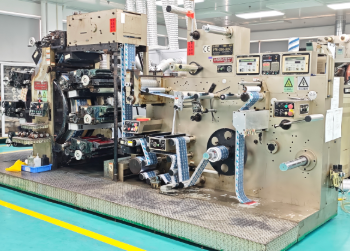
What it does well
There is no stop-start cycle, so the press simply runs. Give it a long order — the same label, hundreds of thousands of copies — and it turns out labels all day.
Registration is the other strength. The web stays pressed against the central drum the entire way round, so tension never spikes the way it does when material is repeatedly accelerated and braked. Colors hold their position. Fine print stays legible. That tight small logo doesn’t wander.
What it costs you
The machine is expensive. Worse, changing jobs is slow: new plates on every station, then register reset across the whole press. On an order of five thousand labels across four different designs, you’re spending most of your time setting up.
Where you’ll find it
Beverage bottles, household and personal care, food packaging label, A large share of the standardized labels on a supermarket shelf came from a press like this.
Semi-rotary presses
The traditional term is reciprocating-feed label press. The material advances a fixed distance, the print unit closes and prints, opens, and the material advances again.
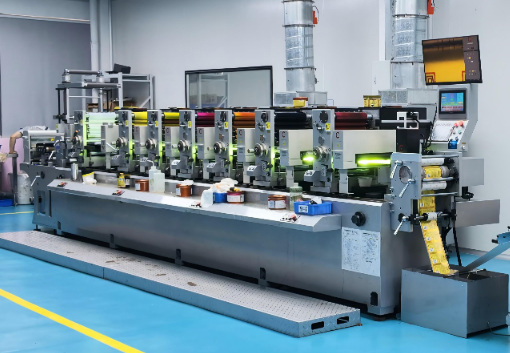
What it does well
That pause is a feature, not a defect. It gives you room to add hot foil stamping, embossing, or screen printing in line. One press handles processes that would otherwise need separate machines.
Money follows the same logic. Lower capital outlay, lighter plate and tooling costs, faster changeover. That combination makes short runs with many different designs viable — and it suits converters whose product mix changes every month.
What it costs you
Start-stop cycling has a ceiling, and a continuous press will always sit above it. On a very large order, the per-label cost stops making sense.
Where you’ll find it
Weigh-price supermarket labels. Limited-edition releases. Craft beer. Premium cosmetics where foil is part of the design. Short runs and heavily finished work — that’s the home ground.
Full-Rotary VS. Semi-Rotary: Which one do you actually need?
Ask what your order book looks like, not which machine is faster.
| Your situation | Choose |
|---|---|
| One design, 100,000+ labels, steady weekly repeats | Full-rotary |
| Many designs, 1,000–20,000 labels each | Semi-rotary |
| Label length changes constantly across jobs | Semi-rotary |
| Fine print or tight registration on a long run | Full-rotary |
| Foil, emboss, or screen in the same pass | Semi-rotary |
| You genuinely can’t predict next quarter’s mix | Hybrid |
That last row is worth a note. Hybrid presses run both modes and switch between them by order profile. They cost more up front and they remove the guesswork — increasingly the default for converters who have outgrown one machine but haven’t outgrown the other.
The takeaway
Full-rotary takes one job and pushes it hard: speed, consistency, register. Semi-rotary handles variety: cheap changeover, flexible tooling, extra finishing in-line.
The label market needs both. Commercial packaging at hundreds of millions of copies a year needs the first. Craft batches, personalization, and premium finishes need the second. Their territories barely overlap — and that’s precisely why the industry keeps both presses running.