
A surf sticker is a vinyl or PVC decal themed around waves, beaches, and surf culture. Most end up on surfboards, skateboards, suitcases, laptops, and water bottles — anywhere a waterproof, UV-stable graphic holds up against salt, sun, and daily handling. The category has split into several distinct sub-markets over the past decade, and the buyers in each one want very different things.
At Yateli, we print custom surf stickers for board shapers, e-foil manufacturers, surf schools, automotive resellers, and Amazon sellers across 60+ countries. The guide below is the same reference we hand to our OEM customers during the quoting stage — what’s actually in a surfboard-grade sticker, how to size it for a real board, and how to wet-apply a large automotive decal without wrinkles. Use it as a working spec, not a marketing piece.
What “Surf Sticker” Means in 2026
The term covers three distinct product formats. Buyers usually only need one, but resellers often stock all three:
- Surfboard-grade waterproof stickers — heavy-duty, custom-shaped, made to live in saltwater
- Automotive surf decals — die-cut vinyls for car, truck, motorcycle, and window surfaces
- Vintage multi-packs — 30–100 sheet sets targeting the sticker-as-accessory market
Each solves a different problem. The pages below break them down by actual factory spec, then walk through material selection, sizing by board type, and wet-method application on cars.
1. Waterproof Stickers for Surfboards
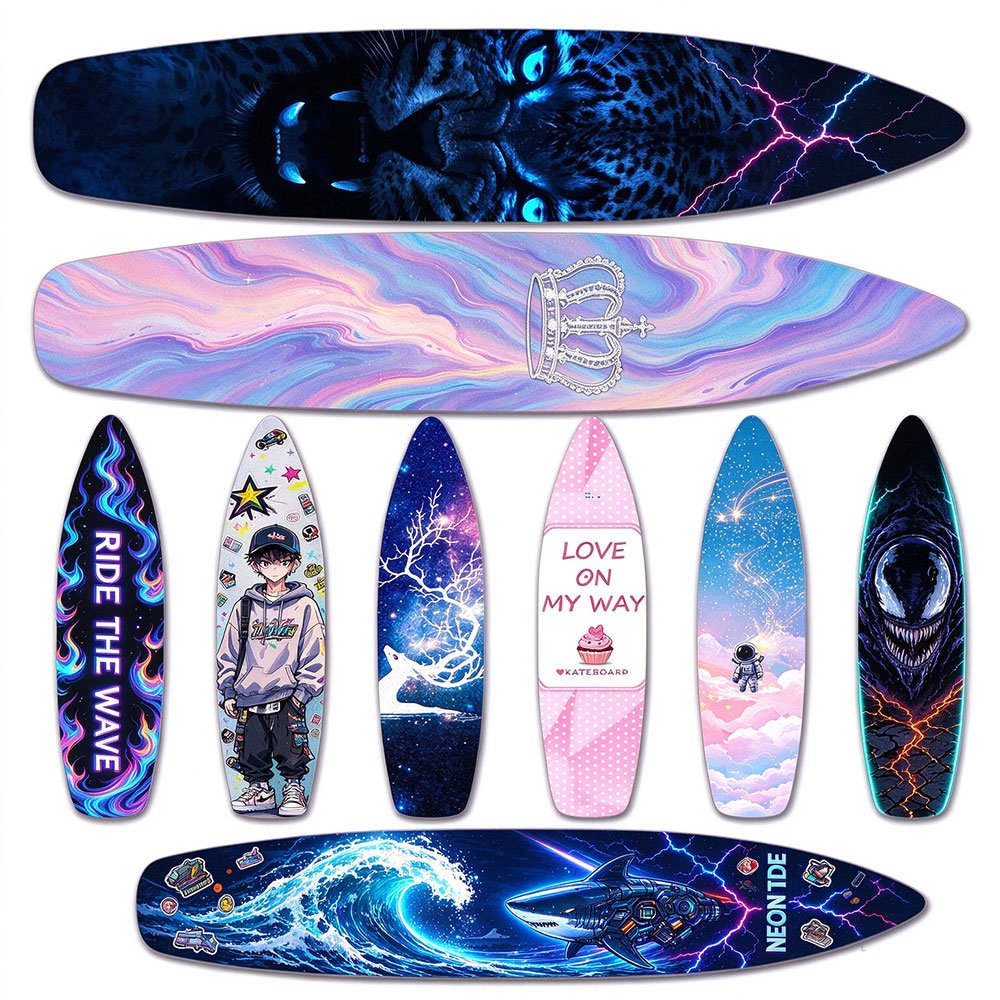
This is the workhorse of our custom production line. The complaint we hear most often — “the edges went white after two months” — almost always traces back to a wrong material spec. Here’s the spec we run for surfboard-grade work, published as the actual production sheet our customers receive:
| Property | Specification |
|---|---|
| Base film | Polyvinyl chloride (PVC) sheet |
| Film thickness | ~70 µm (0.07 mm) standard; custom builds up to 2.35 mm |
| Adhesive | Acrylic — permanent, removable, or high-tack options |
| Outdoor lifespan | ~5 years |
| Rain performance | Submersible after 24-hour cure |
| Standard die-cut size | 670 × 150 mm; fully customizable |
Why PVC Still Wins for Boards
PVC took a reputation hit when cheap monomeric films started clouding up inside one summer. That is a formulation issue, not a material issue. Monomeric plasticizers use short chains that migrate to the film surface and turn hazy under UV. Polymeric plasticizers use longer chains that stay locked in place. Pro shapers and surf brands still spec polymeric PVC for boards because it’s predictable, printable, and survives salt at a fraction of the cost of TPU or PET.
For electric surfboards — sun exposure plus constant splash — polymeric PVC at the 70 µm tier is the right default. Heavier 2 mm+ builds make sense for charter fleets or rental boards, but they’re overkill for personal use.
What This Product Is For
- Custom shapers running branded graphic kits
- E-foil and e-surf manufacturers needing full-deck wraps
- Surf schools branding rental fleets
- Resellers running customizable SKUs at 4–6× markup on Amazon, eBay, Etsy, TikTok Shop
Electric Surfboard Variant
We run a dedicated SKU for the e-foil / e-surf segment. Outdoor PVC, waterproof, UV-stable, removable adhesive — designed for board recoloring, custom paint replacement, and decorative wraps on premium electric boards. Fully customizable on both size and artwork. Sold primarily through Amazon and AliExpress, with end markets in Europe, North America, and South America.
2. Toyota Surf Sticker
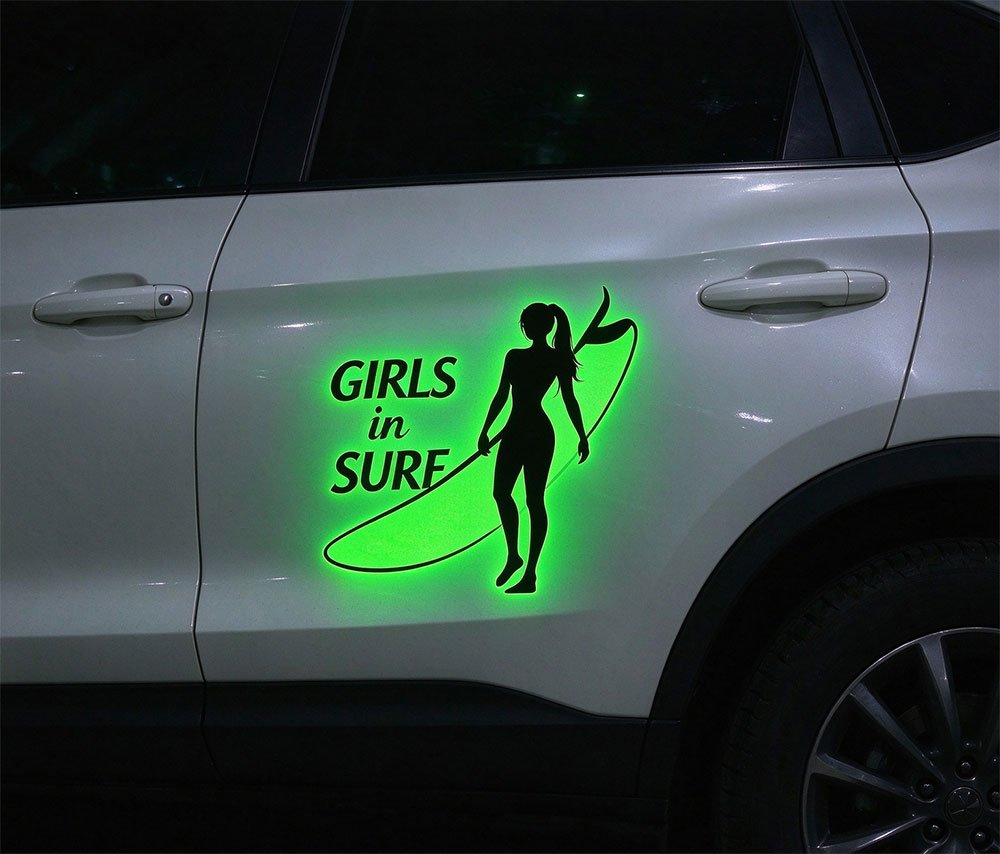
Search results for “Toyota surf Sticker” mix two different products under one term: genuine Toyota body emblems and trim overlays (which we don’t cover here), and surf-themed automotive decals — die-cut vinyl stickers with surfer artwork meant for bumpers, rear windows, motorcycles, and trucks. The surf-themed version is the actual surf sticker market.
Reference Spec — Rosie Decals Hawaii Surfer
| Parameter | Value |
|---|---|
| Color | Gloss White |
| Surface recommendation | Window |
| Recommended uses | Bumper, Car, Motorcycle, Truck, Window |
| Material | Vinyl |
| Theme | Automobile |
| Cartoon character | Surfer |
| Special feature | Waterproof |
| Quantity | 1 piece |
| Style | Modern |
| Size | 6 in / 15 cm tall |
Why Automotive Outranks Boards in Volume
Most surf sticker startups target boards because that’s what the founders ride. Sales data tells a different story. Drivers — not surfers — are the largest single buyer of decorative vinyls, and surf-themed artwork outsells generic wave graphics 2:1 in the 18–34 automotive demographic on Amazon.
The unlock is placement. Car bumpers and rear windows take weeks of sun exposure without ever hitting saltwater, which means mid-tier adhesives survive longer than they would on a board. A modern-style vinyl decal with UV-stable inks runs 3–5 years on a car window with basic care.
What We Build for This Segment
- Reflective vinyl base, 14 × 11 cm
- Gloss white, die-cut to artwork outline
- Cartoon surfer-girl artwork (customizable)
- Application: peel-and-stick
- End market: Europe, North America — young consumer aftermarket, body decoration, personal graffiti styling
What to Look For When Buying
- Die-cut to the artwork outline. No rectangular border, no white frame — the decal looks like part of the body.
- Gloss white or satin finish. Skip full chrome — chrome films haze badly after 18 months of UV.
- 6–10 inch (15–25 cm) range. Large enough to read from a following driver’s view, small enough to stay clear of window-obstruction rules.
Who Buys It
- E-commerce resellers needing high-margin, low-returns SKUs
- Surf culture enthusiasts personalizing trucks, beach cruisers, and motorcycles
- Resellers targeting the touring-bike and overland aftermarket
3. Vintage Surf Stickers (Multi-Pack)
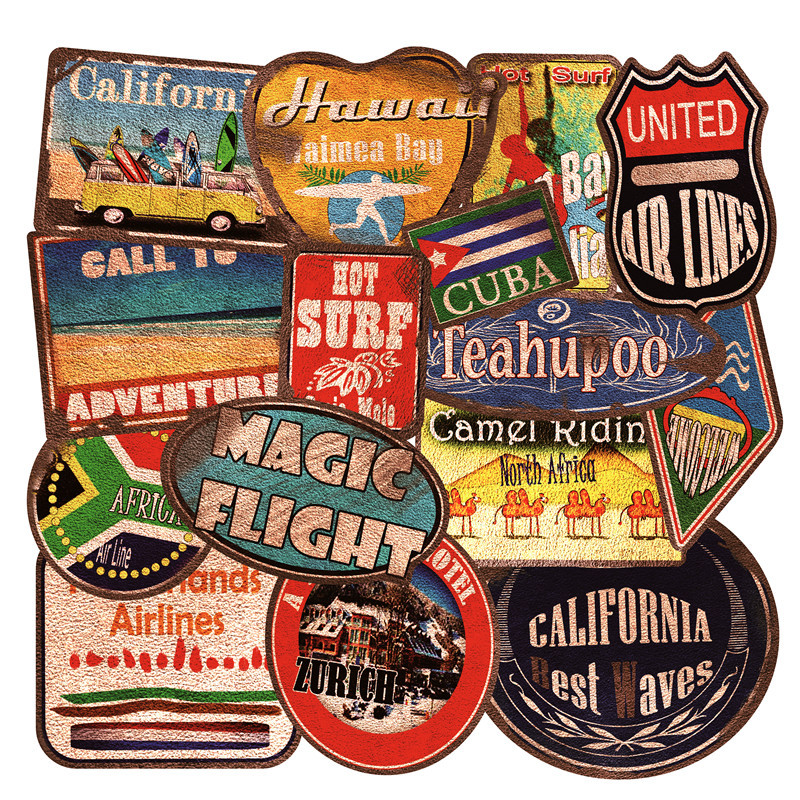
The third format — and the lowest entry barrier — is vintage-themed multi-packs. A search for “vintage surf sticker pack” returns dozens of 30-, 36-, 50-, and 100-sheet sets, mostly printed in China, aimed at teen buyers and stationery shoppers more than actual surfers.
Reference Spec — 36-piece Vintage Surf Pack
| Parameter | Value |
|---|---|
| Style | Vintage / retro |
| Process | UV print + matte overlaminate |
| Adhesive | Low-tack removable, ~2200–2500 CPS |
| Tensile strength | ≥ 0.9 kg/GM |
| Shrinkage | 0.4 mm |
| Service temperature | –40 °C to 100 °C |
| Individual size | ~5–9 cm (mixed) |
| Total weight | ~0.034 kg per pack |
| Material | PVC with matte lamination |
| Pack contents | 36 sheets |
| Packaging | OPP bag |
Why This Format Sells
A 36-sheet pack prices 36 designs at roughly the cost of two single stickers on Amazon. Once the wholesale cost drops to $4–6 per pack, retailers resell at $12–18 and still clear margin after returns. The themes (skateboard, travel, surf, beach, doodle art) are deliberately cross-genre so the same pack sells to a high-schooler decorating a laptop, a college student personalizing a hydro flask, or a parent buying party favors.
The trade-off is durability. Matte-laminated PVC at 70–80 µm will fade and curl within a year of direct sun exposure. These packs are not for surfboards. They’re for laptops, hydro flasks, notebooks, suitcases, bedroom walls, and skateboards.
Construction Highlights
- POLYVINYL CHLORIDE (PVC) waterproof base film — survives rain splashes and hand-wash
- W.P.S.™ UV precision print film top layer — color density and edge sharpness stay locked in after prolonged direct sun
- 2500 CPS trace-free adhesive — peels off clean, no residue, no surface damage, and re-stickable for repositioning during application
Who Buys It
- Stationery and gift-shop wholesalers
- Cross-channel resellers on Amazon, AliExpress, TikTok Shop, Etsy
- Brands sourcing low-cost promo giveaways
- Curated sticker-brand founders using factory blanks
Custom Surf Stickers: Material & Process Selection
For buyers sourcing a custom run — surf brand, board shaper, e-commerce seller — material and process choice drives 80% of the final result. Skip either step and the sticker fails in the field regardless of how good the artwork looks.
Material Decision
| Material | Cost (per m², wholesale) | Outdoor Lifespan | Curve Conformability | Color Range |
|---|---|---|---|---|
| Vinyl (polymeric) | $2–4 | 5–7 years | Excellent | Wide |
| PVC (monomeric) | $0.50–1.50 | 1–2 years | Good | Very wide |
| PET | $4–8 | 5–10 years | Fair | Moderate |
| TPU | $8–15 | 7+ years | Outstanding | Limited |
For a more detailed comparison of different materials, please refer to this article: Self-Adhesive Label Material Comparison
Vinyl is the default for surfboards and most outdoor applications. Flexible, durable, UV-stable, removes cleanly, prints in any color. Skip the “premium TPU” upsell on a $100 foamie — the adhesive layer fails before the TPU does.
PVC is the price-point workhorse for packs and short-term outdoor use. Chemical resistance and abrasion resistance are fine; heat stability is poor. Long-term sun exposure causes yellowing, warping, and edge lift.
PET is the upgrade for permanent installs. Higher temperature tolerance, better corrosion resistance, glossier finish. Worth the cost on commercial signage or branded fleet boards.
TPU is the premium tier. Self-healing against fine scratches, excellent cold-weather flexibility, but limited color range and high cost. Only worth it on high-end boards where the buyer specifically asks for it.
Process Decision
- UV print — the most common process. Vivid color, fine detail, waterproof, UV-stable. The right choice for complex artwork on boards and cars.
- Die-cut — the sticker outline follows the artwork contour with no rectangular background. Looks cleaner on a board, looks like part of the car body on automotive applications.
- Holographic / laser — iridescent rainbow finish. Strong eye-catching effect for retail packs and limited drops. Costs more.
- Foil (gold/silver) — metallic finish, good for accent text and brand logos. Premium positioning without the cost of full holographic.
Field Note
A 70 µm polymeric vinyl printed with solvent ink will outlast a 100 µm polymeric vinyl printed with dye ink every time. Ink chemistry matters more than film thickness. Add a 25–30 µm overlaminate and even mid-grade UV ink stops chalking within a season.
Common Types and Use Cases
Surf-themed stickers break into four working categories. The right format depends on the surface, not the artwork:
- Surfboard-grade stickers — waterproof, scratch-resistant, abrasion-tolerant. Designed to live in saltwater and still identify the board from the lineup.
- Skateboard / land paddle stickers — surf culture is the source code here; surfers in the 1970s were the first to slap brand stickers on skate decks. Today’s versions are hybrid — punk, anime, surf mixed freely.
- Luggage / laptop / hydro flask stickers — the waterproof doodle aesthetic. Marks your suitcase at baggage claim, personalizes gear, no functional purpose beyond identity.
- Kanagawa wave-style — the classic ukiyo-e wave motif. Vintage Japanese aesthetic, popular for wall decals, rear window graphics, and luggage.
The mistake we see most often: customers using a vintage pack sticker on a surfboard. Matte-laminated PVC at 70 µm fades in direct sun within a year, and the adhesive isn’t rated for saltwater immersion. Use surfboard-grade stickers on boards, and reserve pack stickers for indoor and sheltered surfaces.
How to Size Surfboard Stickers
Most sizing complaints — “the sticker was too small,” “it covered my foot,” “it peeled off in a week” — come down to two mistakes: wrong size for the board, or wrong size for the placement. Pick by board type and position first, then adjust for artwork.
Step 1 — Size by Board Type
Board width sets the hard upper limit on sticker size.
| Board | Deck Width | Recommended Sticker Size |
|---|---|---|
| Shortboard (5’8″–6’6″) | 45–55 cm | 5–9 cm as the default. Large logos no more than 15 cm — anything bigger eats into stance space. |
| Funboard / mid-length (7’0″–8’0″) | 55–65 cm | 8–15 cm is the working range. Nose and tail can take up to 20 cm graphics. |
| Longboard (9’0″ and up) | 60–70 cm | 10–20 cm on nose, tail, and bottom for the most balanced look. |
Step 2 — Size by Placement
Different parts of the board have different available space and different stress loads. Size mismatch here is what kills a sticker before its rated lifespan.
Nose. Rarely foot-loaded, short immersion time. Use 10–15 cm mid-to-large designs — your own board becomes instantly recognizable in a crowded lineup. On shortboards, don’t stick the decal right at the very tip; high-pressure water during dolphin jumps lifts even well-bonded edges.
Mid-deck / foot zone. Hard rule: nothing larger than 7 cm under your back foot. Stick to 3–6 cm decals placed along the stringer line, away from wax buildup and foot pressure. Anything bigger gets shredded within a few sessions.
Bottom. Large, open, no foot traffic — the natural home for brand logos. 13–19 cm is the standard range. For reference, LOST’s medium logo sticker is 7.6 × 19 cm. A correctly placed bottom sticker gives any board a pro-shaper finish.
Rails. Curved surfaces are unforgiving. Keep width under 5 cm and stick to slim, elongated logo shapes. Wide decals on rails lift at the edges almost immediately.
Step 3 — Shortcuts When You’re Not Sure
- Default to a 5–8.5 cm (2–3.35 in) mixed-size pack. Most factories stock these in 50- or 100-sheet sets. They fit shortboards and longboards equally well and have the highest tolerance for sizing mistakes.
- Print the artwork at 1:1 scale and hold it against the board before ordering. Readable from about 6 feet (2 meters) away means the size is correct.
- Don’t get greedy. A sticker larger than one-third of the deck width won’t sit flat — and on a moving board it adds drag you can feel on a clean wave.
How to Apply Car Surf Stickers
For automotive applications, the wet method is the only approach we recommend to OEM buyers and resellers. It has the highest error tolerance and works on doors, trunks, hoods, and rear windows. For decals over 30 cm in any direction, use two people. One person handling a full hood graphic solo usually ends with a misalignment or a wrinkle that can’t be fixed.
Tools and Supplies
- Cleaning: lint-free microfiber cloth, 50% isopropyl alcohol (or rubbing alcohol). No alcohol on hand? Soapy water works.
- Tools: squeegee (or a credit card wrapped in a soft cloth), spray bottle, utility knife, pin for popping bubbles.
Six-Step Process
1. Clean the body panel. Wash the application area thoroughly, then wipe it down with alcohol to remove oil, wax, and dust. Wait until the surface is completely dry before moving on.
2. Position the sticker. Choose a flat, smooth section of the body. Avoid door handles, lights, and pronounced curves. Roughly position the artwork first, then secure one corner with masking tape — this turns the sticker into a hinge so you can lift it back if alignment is off.
3. Spray water for positioning. Mist a fine layer of soapy water (a few drops of dish soap in a spray bottle of water) on both the car body and the back of the sticker. The water breaks the initial tack of the adhesive, so the sticker slides freely while you align it.
4. Peel and apply. Remove the backing paper, line up the sticker, and lower it onto the panel. Using the squeegee, work from the center outward in overlapping strokes. Push the soapy water and any trapped air toward the edges.
5. Work the edges. When you reach a door seam, handle, or body line, use the utility knife to make a small relief cut so the vinyl wraps cleanly into the recess instead of lifting at the corner.
6. Final check. Confirm no visible bubbles, then peel off the clear transfer tape at a shallow angle. Small bubbles — prick with the pin and squeegee flat. Do not wash the vehicle or expose it to heavy rain for at least 24 hours. The adhesive needs a full day to reach its final bond strength.
Specs at a Glance — All Three Products
| Category | Base Material | Thickness | Adhesive | Lifespan | Customization |
|---|---|---|---|---|---|
| Surfboard waterproof | Polymeric PVC | 70 µm standard, up to 2.35 mm | Acrylic (permanent / removable / high-tack) | ~5 years outdoor | Size + artwork |
| Toyota surf (automotive) | Vinyl | 80–100 µm typical | Pressure-sensitive acrylic | 3–5 years outdoor | Size + artwork |
| Vintage multi-pack | PVC + matte laminate | 70–80 µm | 2200–2500 CPS removable | Indoor / sheltered | Pre-set designs |
Why Source from Yateli
We print custom surf stickers in Guangdong — UV + lamination lines, polymeric and monomeric PVC stock, polymeric vinyl, PET, and TPU available on request. OEM/ODM orders start at typical 50–100 piece MOQs depending on material and finish. Full spec sheets ship with every quote, including film thickness, adhesive type, ink chemistry, and overlaminate construction.
Send us your artwork and target board or vehicle. We’ll spec the right material, adhesive, and finish in one reply, with a working sample within five business days for most projects.
Contact: sales@mhlabel.com · Request a quote