
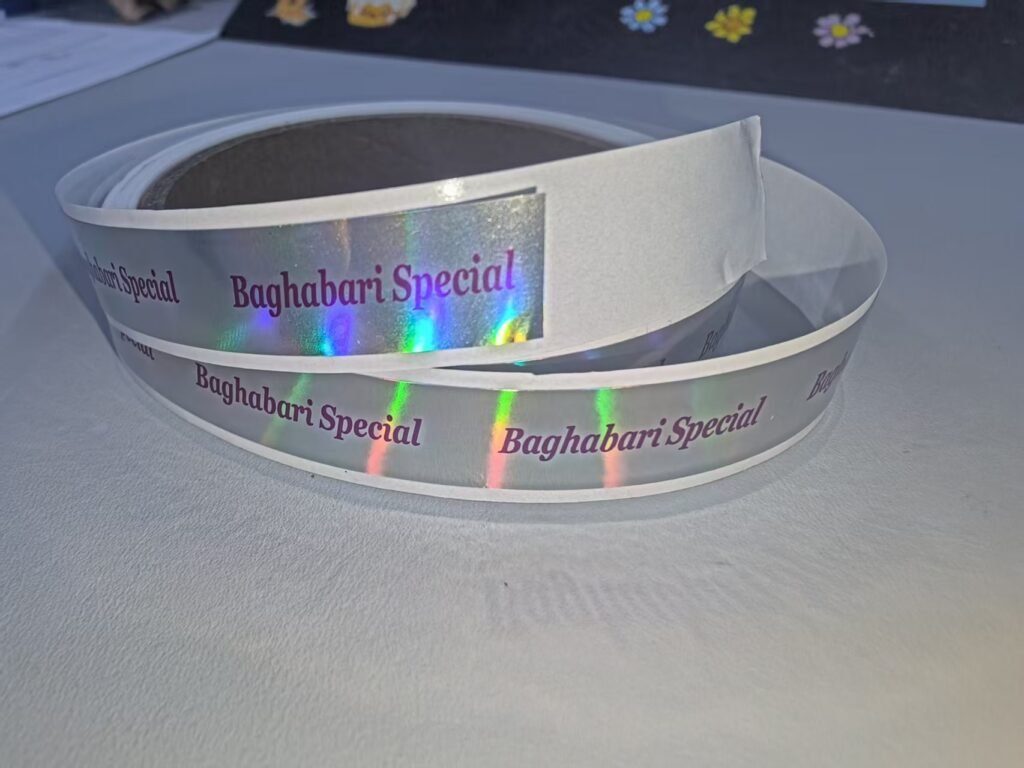
Curling edges, label drop-off, fading, blistering – the label was wrong before the press even spun up. Most of these failures are material decisions, not printing decisions.
Stuck between kraft, PE, and PI on a 130 C conveyor line? We have walked that exact job. Send the spec; we will return three working combinations in 24 hours.
Contents
- Section 1 – The “Sandwich” Anatomy of a Self-Adhesive Label
- Section 2 – Choosing the Face Stock: Paper vs. Film
- Section 3 – Choosing the Adhesive: The Hidden Engineer of Every Label
- Section 4 – Choosing the Liner: Don’t Underestimate the “Backing Paper”
- Section 5 – Finishing and Conversion: Making Labels That Work and Sell
- Section 6 – Eight-Industry Quick-Pick Matrix
- Section 7 – Selection Pitfalls: The 5 Costliest Mistakes
- Section 8 – Frequently Asked Questions
- Section 9 – Still Unsure? Hand It to a Specialist
Section 1 – The “Sandwich” Anatomy of a Self-Adhesive Label
A pressure-sensitive label is a three-layer laminate. Get the layers right and the label outlasts the product. Get them wrong and no printer, no die-cutter, no applicator can save it downstream.
| Layer | Role | Selection Keywords |
|---|---|---|
| Face Stock | The “face” – carries the printed graphic | Substrate, caliper, surface energy |
| Adhesive | The “hand” – bonds label to the substrate | Adhesive chemistry, tack, shear, peel |
| Release Liner | The “tray” – protects the adhesive in storage | Release force, flatness, stiffness |
Rule #1: pick the adhesive first, then the face stock, then the liner. Skip this order and nothing else recovers. The adhesive decides if the label stays put; the face stock decides if it looks right and survives.
Section 2 – Choosing the Face Stock: Paper vs. Film
Face stock sets the look and the baseline toughness. First fork in the road: paper or film. Most calls come down to cost, water, and how long the label needs to live.
2.1 Paper-Based Face Stocks (cost-efficient, default for dry indoor use)
New to the three-layer build? Start with our self-adhesive label primer – 5-minute read, then come back.
| Face Stock | Characteristics | Typical End Uses |
|---|---|---|
| Art Paper | Excellent print fidelity, low cost, no water resistance | Food labels, shipping, pharma |
| Writing Paper | Hand-writable, jet/laser printable | Office labels, asset tags |
| Direct Thermal | Prints without a ribbon, heat- and light-sensitive | Courier waybills, POS receipts, retail shelf tags |
| Thermal Transfer | Ribbon-printed, longer image life than direct thermal | Warehouse bin labels, hang tags |
| Top-coated Economy Thermal | Water-, grease-, scratch-resistant, no ribbon needed | Courier waybills, POS receipts, retail shelf tags |
2.2 Film-Based Face Stocks (waterproof, required for harsh environments)
Side-by-side specs (thickness, temperature, water/oil resistance, standard sizes) for every paper and film family live in our label material comparison page. Use it once the field is narrowed to two or three candidates.
| Face Stock | Service Temp | Characteristics | Typical End Uses |
|---|---|---|---|
| PET (Polyester) | -40 to 150 C | Heat- and chemical-resistant, dimensionally stable – the “all-rounder” of films | Electronics, outdoor, high-temperature |
| PP (Polypropylene) | -20 to 80 C | Flexible, water-resistant, squeezable | Personal-care tubes, beverage labels |
| PVC (Polyvinyl Chloride) | -10 to 60 C | Flexible, weatherable, vivid print, restricted by environmental regulation | Outdoor signage, vehicle decals |
| PE (Polyethylene) | -40 to 60 C | Highly flexible, performs at low temperature | Cold-chain labels, squeeze-bottle labels |
| Synthetic Paper | -20 to 90 C | Paper feel with film-class water resistance | Seafood and fresh-produce labels |
How to Tell PET from PVC
Quick ID, no lab needed:
- PET: hard, glassine-smooth surface, snaps back quickly when bent; tears with a crisp “click” and a clean break.
- PVC: softer, slightly tacky-smooth; permanent whitening crease when folded; tough with no clean crease.
Burn Test
- PET: does not blacken while burning; smoke carries a faint sweet note.
- PVC: blackens while burning; sharp acrid odor, self-extinguishes when flame is removed.
How to Tell PET from BOPP
- PET: hard, stiff, smooth; snaps back fast, no crease memory; crinkles with a crisp “gaga” sound.
- BOPP: softer, slightly draggy feel; permanent whitening crease when folded; crinkles with a muffled “ga-la ga-la” sound.
Water-Float Test
- PET density > 1, sinks in water.
- BOPP density < 1, floats in water.
Blown PE vs. Calendered PE
- Blown film: matte or semi-matte, softer hand, corona treatment required for printing.
- Calendered film: mirror-flat surface, superior color reproduction, no corona treatment required.
Die-Cutting Behavior
- Blown film: matrix curl during waste stripping, requires operator skill.
- Calendered film: clean die-cut, smooth waste stripping, ideal for high-speed dispensing.
Application Note – Pearlescent Synthetic Paper
Pearl synthetic paper WILL DELAMINATE under adhesive tape. This warning bears repeating because the failure is silent. Pearl synthetic paper is built on a polypropylene (PP) substrate, which is a low-surface-energy, chemically inert material. Standard tape adhesives cannot form a true bond with the surface, so the label looks stuck but the interface is structurally weak.
2.3 The 30-Second Decision Rule
Five lines, five answers, no spreadsheet:
- Dry indoor use, budget-sensitive -> paper family (start with art paper)
- Will contact water, oil, or solvents -> film family (PET/PP)
- Substrate will flex or be squeezed (tubes, small bottles) -> PE/PP
- Outdoor exposure longer than 1 year -> PET or PVC
- High-temperature exposure (80 C and above) -> PET, or specialty high-temp face stock when justified
Section 3 – Choosing the Adhesive: The Hidden Engineer
Adhesive gets the least attention and does the most work. Pick the wrong chemistry and the label peels, ghosts, or disappears – no face stock in the world can rescue it.
3.1 Adhesives Classified by Bonding Behavior
| Adhesive Type | Characteristics | Best For | Pitfall |
|---|---|---|---|
| Permanent | Cannot be cleanly removed; aggressive bond | Most industrial labels | Misplaced label = scrap |
| Removable | Repeated peel-and-stick, no residue | Promotional, price, temporary marking | Avoid for long outdoor use |
| High-Tack | Very high initial tack, bonds rough surfaces | Tire labels, rough corrugate, wood | Difficult matrix stripping |
| Freezer-Grade | Bonds below -18 C | Cold-chain food, frozen packaging | Warm up before application |
| High-Temperature | Survives 120 C+ environments | Electronics reflow, automotive engine bay | Pair with high-temp face stock |
| Water-Soluble | Dissolves in water, residue-free removal | Returnable glass bottles, dishware | Never use in humid environments |
3.2 The Three Questions That Pick the Right Adhesive
- How long must it stay on? Temporary, go removable. Permanent, go permanent.
- What is it sticking to? Low-surface-energy stuff (PP, PE, powder-coated paint), go high-tack. Rough corrugate, wood, tire rubber, go high-tack.
- What does it have to survive? Freezer, go freezer-grade. Oven or engine bay, go high-temp. Wash-and-recycle, go water-soluble.
Section 4 – Choosing the Liner: Don’t Underestimate the Backing Paper
The liner is the “boring” layer that quietly decides if your line runs or jams. It guards the adhesive in storage and dictates how cleanly the label releases at the peel plate. On automatic lines, it is the biggest single variable.
| Liner Type | Characteristics | Best For |
|---|---|---|
| Glassine | Flat, translucent, excellent die-cutting | Automatic labeling, high-speed lines |
| Kraft | Low cost, high stiffness | Manual application, general labels |
| PET Transparent | High strength, no breaks | Ultra-high-speed lines, film face stocks |
| White Calendered | Opaque, stiff, strong | Sheet-fed printing, manual application |
| Yellow Kraft (120/140 g) | Heavy, moisture- and grease-resistant, heat-tolerant | Large-format labels, heavy-duty shipping |
| Blue Glassine | Flat, translucent, excellent die-cutting | Automatic labeling, high-speed lines |
Decision Rhyme: hand-apply -> kraft, machine-apply -> glassine, ultra-high-speed -> PET liner.
Section 5 – Finishing and Conversion: Making Labels That Work and Sell
Post-press finishing shapes feel, durability, and anti-counterfeit power. Rule of thumb: function first, bling second. A beautiful laminate that delaminates is a waste of foil.
| Process | Function | Best For |
|---|---|---|
| Gloss Laminate | Brightens, waterproofs, adds wear resistance | Personal care, food |
| Matte Laminate | Premium feel, anti-fingerprint, scratch resistance | Wine, cosmetics, premium brands |
| Hot Foil (Gold/Silver) | Elevates perceived quality, anti-counterfeit aid | Wine, gifting, health products |
| Spot UV | Localized gloss, draws the eye | Labels needing visual hierarchy |
| Silk-Screen | Heavy ink deposit, tactile feel, Braille | Electronics, tactile signage |
| Anti-Counterfeit (thermochromic / fluorescent / holographic) | Anti-diversion, anti-fake | Brand-protection programs |
| Variable Data (1-of-1 codes) | Traceability, marketing, anti-diversion | F&B, agricultural inputs, 3C electronics |
| Transfer Film | Image transfer, anti-counterfeit, strong adhesion | Security labels, electronics panels, premium packaging |
| Soft-Touch Laminate | Velvet hand, scratch- and moisture-resistant, premium feel | Luxury, beauty, premium gifting labels |
| Reverse Matte-Gloss | Gloss-matte coexistence, sharp contrast, dimensional depth | Premium wine, personal care, brand logos |
| Cold Foil | Metallic look, no heat, fine gradients | High-end packaging, security labels, short-run |
Section 6 – Eight-Industry Quick-Pick Matrix
See your application in the list? Copy the row and run with it. We have already done the comparison for you.
| Application | Face Stock | Adhesive | Finishing | Key Caution |
|---|---|---|---|---|
| Food and Beverage | Art paper / PP | Permanent (freezer-grade for frozen) | Laminate + foil | Freezer items require freezer-grade adhesive; apply at chilled-line temperature |
| Personal Care | PP / PE | Permanent | Gloss laminate | Squeezable tubes -> PE; watch for oil-canning |
| Pharma and Health | Art paper / PET | Permanent | Laminate + security | Compliance first; align with primary packaging regs |
| Electronics | PET | High-temperature permanent | Screen print / laminate | Reflow process demands full high-temp system |
| E-Commerce Logistics | Direct thermal / Art paper | Permanent / high-tack | No laminate | High-speed dispensing requires glassine liner |
| Automotive Parts | PET | High-tack + heat-resistant | Laminate | Oil, weathering; design life measured in years |
| New-Energy Battery | High-temp PET / specialty film | High-temperature | Laminate + print | 150 C+, flame-retardant and thermal-conductive grades by spec |
| Outdoor Signage | PVC / PET | Permanent | Laminate + UV | Weathering 2 to 3 years; UV protection mandatory |
Section 7 – Selection Pitfalls: The 5 Costliest Mistakes
These five mistakes show up in roughly four out of five support tickets. Read them once, save yourself a phone call.
- Spec the face stock before the adhesive – the leading cause of drop-off and curl. The adhesive always outranks the face stock in the decision tree.
- Ignore the substrate’s surface energy – PP/PE bottles with a standard adhesive is a guaranteed drop-off. Confirm substrate material before quoting.
- Select at room temperature, deploy in the cold – 90% of cold-chain label edge-lift comes from a room-temperature adhesive. Application temperature and service temperature are different specs – both must be specified.
- Skip the laminate to save cost – an outdoor label without a laminate fades within three months and is scrapped. The “saving” turns negative once replacement labor is included.
- Lab-only qualification – a label that passes lab tests can still break on a high-speed production line. Always validate on the actual line, at the actual speed, with the actual substrate.
Section 8 – Frequently Asked Questions
The five questions our service desk hears every week, answered straight.
Q1 – How long until a freshly applied label reaches full bond strength?
24 to 48 hours, on average. Sending a label into a freezer or an oven before the dwell is the same as skipping the glue.
Q2 – My labels won’t stick in winter. What should I do?
Adhesive chemistry goes sleepy when it is cold. Three fixes, in order: warm the substrate, warm the application room to 10 C+, or switch to a low-temperature adhesive.
Q3 – Can I put an art-paper label in the freezer?
Chilled case, fine. Freezer, no – the paper absorbs moisture and falls off. For freezers, go film face stock + freezer-grade adhesive.
Q4 – Why does my automatic applicator keep snapping labels?
Suspect the liner first – swap to glassine or PET. Then check die-cut depth; a cut that is too deep scores the release layer and the label tears at dispense.
Q5 – Can you do special shapes and special substrates?
Yes. Punched, contour die-cut, and multi-layer constructions (for example, high-temperature multi-layer pressure-sensitive labels) are all in our custom shop. Send the end-use scenario and our engineering team will quote the build within 24 hours.
Section 9 – Still Unsure? Hand It to a Specialist
Selection boils down to one sentence: scenario defines material. Send us these four things and a locked-in spec comes back the same day:
- What it sticks to – substrate material and surface condition
- How long it must last – required service life
- What environment it sees – temperature, humidity, chemicals, UV
- How it is applied – manual or automatic, line speed
Free Sample Run – 1-on-1 Technical Selection Consultation
- 20+ years of adhesive and label-substrate engineering; 50+ invention patents
- Million-class testing laboratory; 128 performance tests behind every recommendation
- 24-hour sample turnaround; OEM/ODM mass customization supported
- Test methods aligned to FTM, ASTM, JIS, GB and other global standards